Three-Wood End-Grain Cutting Board: Walnut, Cherry & Maple
Two woods is the classic. Three is where end-grain cutting boards become genuinely memorable.
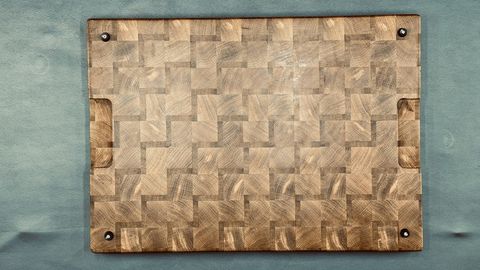
Most cutting board makers start with two woods. The walnut-and-maple pairing is a proven formula, and cherry-and-walnut brings warmth and depth. But adding a third species opens design territory that two simply can't reach.
The most popular three-wood combination — walnut, cherry, and maple — works because the tones are evenly spaced across the value scale. Maple is light. Cherry is mid-tone. Walnut is dark. That even distribution means almost any arrangement looks balanced, which gives you room to experiment without the risk of an ugly result.
The Three Species at a Glance
Hard maple (Acer saccharum) is the lightest of the three and the hardest at 1450 lbf on the Janka scale. Tight grain, creamy white surface, and easy to work. It's the foundation species — bright enough to make the darker woods pop.
Black cherry (Prunus serotina) sits in the middle at 950 lbf Janka. Raw cherry is a peachy pink-tan that darkens dramatically to rich reddish-brown over its first year of light exposure. That color evolution means the board improves with age. Cherry also has a naturally silky surface after sanding that responds beautifully to oil.
Black walnut (Juglans nigra) anchors the dark end at 1010 lbf. Deep chocolate-brown heartwood, open grain, and a slightly coarser texture than maple. It's the visual anchor of any composition.
Together, these three cover the full tonal range using domestic North American hardwoods that are widely available, food-safe, and well understood by any lumberyard or woodworking supplier.
Arrangement Styles
With three species, the arrangement options multiply quickly. Here are the four most useful starting points:
Balanced Stripe (W–C–M Repeat)
The simplest approach: walnut–cherry–maple, repeat. The three-species repeat creates a rhythm that reads as fine textile at narrow strip widths and bold graphic at wider ones.
| Strip width | Board width | Strips needed |
|---|---|---|
| ¾ inch | 12 inches | ~16 (5–6 repeats) |
| 1 inch | 12 inches | ~12 (4 repeats) |
| 1¼ inch | 12 inches | ~9 (3 repeats) |
Center Focal Point
Arrange walnut strips symmetrically from the center outward, with cherry and maple filling toward the edges. The darkest wood in the center creates visual weight — the board feels anchored and intentional.
Gradient
Dark to light across the board: walnut on one edge, transitioning through cherry to maple on the other. The result is dramatic, especially viewed from above. It requires planning because the transition is asymmetric, but the payoff is a board that looks like it belongs in a gallery as much as a kitchen.
Accent Row
Use a two-wood primary pattern (alternating walnut and maple) with a single cherry row placed at the center or offset. The accent row acts like a brushstroke through the composition — subtle but impossible to miss.
Ratio Decisions
How much of each species you include changes the personality of the board:
| Ratio (W : C : M) | Effect |
|---|---|
| 1 : 1 : 1 | Balanced, equal representation |
| 2 : 1 : 2 | Dark-dominant with cherry accent |
| 1 : 2 : 1 | Cherry-forward, earthy mid-tone |
| 1 : 1 : 2 | Maple-dominant, light and bright |
| 2 : 2 : 1 | Rich and warm, minimal maple |
No ratio is wrong — the right choice depends on the space the board is going into. A dark kitchen with walnut countertops might call for a maple-dominant board for contrast. A bright, minimalist kitchen might benefit from the depth of a walnut-heavy design.
How the Colors Age
This is where the three-wood combination gets genuinely interesting. The species evolve on different timelines:
Maple stays relatively stable, picking up a slight amber warmth over years of mineral oil and light exposure. It remains the brightest of the three throughout the board's life.
Cherry undergoes the most dramatic change — starting pale and pinkish, deepening to rich reddish-brown within 6 to 12 months. By year two or three, well-oiled cherry approaches the initial color of walnut heartwood.
Walnut lightens slightly with long-term light exposure but remains dark relative to the others.
The practical implication: your three-wood board at year one looks noticeably different from year three. The cherry-to-walnut contrast narrows over time as cherry deepens; the maple-to-cherry contrast grows as cherry darkens away from maple. Boards with strong maple presence often improve as the gap between maple and the two darker woods becomes more dramatic.
Design with the aged appearance in mind, not just the day-one look.
Glue-Up Notes for Three Species
The main consideration with three species is managing the assembly window. More strips means more surfaces to coat and align before the glue starts to grab. A few things that help:
- Stage everything before opening the glue bottle. Lay out all strips in sequence. For a 12-inch board at 1-inch strips, that's 12 strips to arrange correctly — simple enough, but doing it dry first prevents a scramble at the glue table.
- Watch walnut-adjacent maple seams. Walnut tannins are water-soluble and can migrate into neighboring maple under wet glue conditions, leaving a faint gray or greenish tinge at the joint. A quick shellac sealer coat on walnut faces before gluing stops the migration.
- Cherry is the easiest of the three. It glues readily, accepts finish evenly, and doesn't present the migration issues of walnut.
- Flatten before crosscutting. Three species with slightly different expansion coefficients can introduce minor warp into the glued slab. A pass through a drum sander or a session with a hand plane before crosscutting ensures flat slices.
Planning the Layout Before You Cut
Three-wood layouts are where visual planning software earns its keep. With a simple walnut-and-maple stripe, the math is easy on paper. But when you're deciding whether a 2:1:2 ratio looks better than 1:1:1, or whether the gradient should run left-to-right or right-to-left, working from a live preview changes everything.
Cutting Board Designer lets you arrange walnut, cherry, and maple layers in any order, adjust strip widths, and preview the end-grain mosaic in 2D and 3D before anything gets cut. Drag layers to reorder, tap a row to adjust its width, and flip or rotate to see how the pattern sits on the counter. Once the layout is set, the app generates a complete cut list with blank dimensions, slice count, and kerf-adjusted totals.
For a three-wood board especially, 15 minutes with the app before the lumber yard will save you from buying the wrong ratio of each species — or discovering after the glue-up that the cherry accent you planned for the center is actually off by a strip.
Start Simple, Then Experiment
If this is your first three-wood board, start with the balanced 1:1:1 stripe. Equal representation of all three species removes the ratio decision from the equation and lets you focus on the construction. Once you've built one, the appetite for something more ambitious — a gradient, an accent row, a center focal point — arrives on its own.
For the full planning sequence including kerf math, board thickness, and slice count, see the end-grain cutting board design guide. The three-wood board follows the same process as any end-grain build; the only thing that changes is how many species you're tracking through each step.
Ready to see what your layout looks like? Cutting Board Designer has walnut, cherry, and maple built in — drag them into any arrangement and get a cut list in minutes.