5 End-Grain Cutting Board Mistakes Beginners Make
Most first-timer end-grain cutting boards fail long before the glue-up — and every mistake is preventable with a little upfront planning.
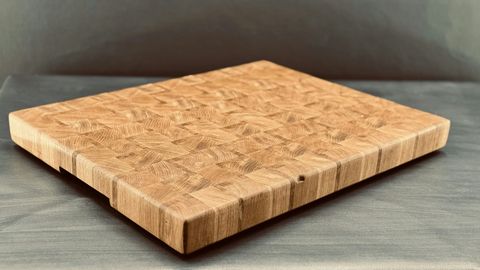
End-grain cutting boards are one of the most rewarding woodworking projects you can build. They're also one of the most unforgiving. Unlike a face-grain slab where a slightly wrong measurement just means a shorter board, an end-grain build involves two separate glue-ups, multiple species, and a cut list where every dimension compounds. Get one number wrong and you either run out of material halfway through or finish with a board too thin to survive a single resurfacing.
These are the five mistakes that sink most first builds — and how to fix them before you touch the table saw.
Mistake 1: Not Accounting for Blade Kerf
This is the most common error, and it's invisible until it's too late. Every time your saw blade passes through wood, it consumes material — typically 1/8 inch for a standard full-kerf blade, or around 3/32 inch for a thin-kerf blade. That lost material is called the kerf, and on an end-grain board it adds up fast.
Here's why it matters more than people expect: an end-grain build involves cutting a panel into strips, then gluing those strips up on their side. If you're cutting 12 strips from a 10-inch panel, you lose nearly 1.5 inches of material to kerf alone with a standard blade — before a single plane pass. Miss that in your math and your finished panel comes up short.
The fix: always include kerf in your cut list. Count how many rip cuts your plan requires and multiply by your blade's kerf width. Add that to your required blank width. If your plan calls for 10 strips at 3/4 inch from a face-grain blank, you need at least (10 × 0.75) + (9 × 0.125) = 8.625 inches — not 7.5.
Cutting Board Designer handles this automatically: enter your blade kerf in the settings and the app adjusts the total required blank width in real time. It's one of those things that sounds minor until you're three strips short with no more matching walnut in the shop.
Mistake 2: Skipping the Flatten Between Glue-Ups
An end-grain board is built in two stages. First you glue strips face-to-face into a wide panel (a "face-grain sandwich"). Then you rip that panel into new strips, rotate them 90 degrees so end grain faces up, and glue those together. Between those two stages, the panel must be flat.
Beginners often skip straight from the first glue-up to the rip saw. The problem: every glue-up introduces some bow or twist, even tiny amounts. When you rip a bowed panel into strips and glue those strips end-to-end, every strip inherits the bow and the joints telegraph the distortion into the finished board. Gaps appear. Stress cracks follow.
Run the panel through a drum sander, planer, or hand-plane it flat before ripping. Both faces flat, both edges square. This one step is the difference between a board that's dead flat after the second glue-up and one that requires embarrassing amounts of belt-sanding to flatten — or can't be saved at all.
Mistake 3: Building with Unacclimated Wood
Buying lumber on Saturday and building on Sunday is tempting. It's also how you end up with a board that cups within a week of finishing.
Wood is hygroscopic — it absorbs and releases moisture as humidity changes, and it moves as it does. Freshly purchased lumber (even kiln-dried) often hasn't reached equilibrium with your shop's humidity. If you glue it up before it stabilizes, the wood will try to move after the glue cures. On a face-grain board that's manageable. On an end-grain board with multiple species glued in alternating orientations, the movement stresses every joint simultaneously.
Standard guidance is 48–72 hours of acclimation in your shop before milling. Stack the boards with stickers (thin strips between layers) so air can circulate on all faces. This is especially important for dense exotics like ebony or jatoba, which have higher density and can move less predictably than domestic hardwoods.
If your shop humidity swings dramatically season to season, consider building in the season closest to your kitchen's typical humidity. A board built in a damp summer shop that lives in a dry winter kitchen is going to be unhappy.
Mistake 4: Undersizing Your Strip Height
The "height" of your strips in the face-grain panel becomes the thickness of your finished end-grain board. Beginners routinely underestimate how much material disappears between the second glue-up and a finished, flat board.
After the second glue-up you'll flatten the top face, flatten the bottom face, and sand through several grits. That typically removes 1/8 to 3/16 of an inch from the total thickness. If your strips were exactly 1.5 inches tall and you needed a 1.5-inch finished board, you're already short before the first sandpaper hits the surface.
Plan for at least 1/4 inch of extra thickness above your target finished dimension — more if you're new to glue-ups and your blanks tend to come out with more variation. A 1.75-inch strip height comfortably yields a 1.5-inch finished board even with a less-than-perfect second glue-up.
This matters even more if you're adding a juice groove, which requires at least 1.5 inches of finished thickness to route cleanly. Read through the guidance in the end-grain cutting board design guide before you set your strip dimensions — the thickness math is worth getting right before milling.
Mistake 5: Clamping Too Hard (or Not Hard Enough)
Glue-up clamping is where a surprising number of builds fail at the last step. Both extremes cause problems.
Too little pressure leaves gaps that look like tight joints until the glue cures and the board dries — then you see the dark line. Glue doesn't fill gaps; it bonds surfaces in contact.
Too much pressure is the less obvious culprit. Overtightening clamps crushes wood cells at the joint, expels nearly all the glue (dry joint), and can crack a strip if it's forced against a slightly bowed neighbor. The target is firm, even pressure — enough to close the joint completely, not enough to make the clamps groan.
The practical test: a thin bead of glue squeeze-out along the full length of every joint. No squeeze-out means too little pressure. A thick rope of glue means too much. Wipe the excess with a damp rag; don't let it cure on the end grain where it'll seal the wood and prevent the finish from penetrating.
Alternate your clamps above and below the panel during the second glue-up. This keeps clamping pressure centered and prevents the panel from curving like a taco as it dries.
Plan First, Cut Second
The best way to avoid all five mistakes is to design the board completely before you buy or mill anything. Know your finished dimensions, strip counts, kerf allowances, blank thickness targets, and species placement before the first rip cut.
The choosing the best wood for a cutting board guide is a good starting point if you're still picking species. Once you know your woods, use Cutting Board Designer to lay out the full pattern, set your kerf, and generate a cut list that accounts for material loss at every stage. Going into the build with a complete plan — not a rough sketch — is the single biggest predictor of a board that comes out the way you imagined it.