Cherry and Walnut: A Warm End-Grain Pairing
Two warm-toned hardwoods that start understated and deepen into something extraordinary over years of kitchen use.
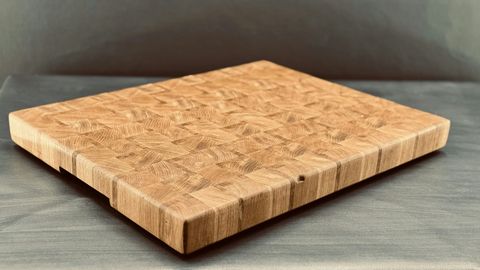
Walnut and maple gets all the attention. It's the high-contrast workhorse — dark brown against creamy white, dramatic from the first strip and reliable in every build. But pair walnut with cherry instead, and you get something quieter and, in the long run, more interesting: two warm species whose colors shift and deepen with age, converging toward a richly toned board that looks nothing like it did the day you finished it.
Cherry-and-walnut is the board makers build after walnut-and-maple. Once you've nailed the classic, this is where a lot of people go next.
Why This Pairing Works
The contrast here isn't the sharp black-and-white of walnut-and-maple. It's more like the difference between two relatives — recognizably related, but clearly distinct.
Black cherry (Prunus serotina) freshly planed looks pale: a light tan to pinkish-orange. New boards made with cherry often disappoint people who expected something bolder. Give it time. Within months of light exposure, cherry undergoes a dramatic photochemical shift — the pale sapwood darkens to a warm amber, and the heartwood develops its signature reddish-brown with golden undertones. A cherry board at five years old looks nothing like it did at five weeks.
Black walnut (Juglans nigra) runs the opposite direction in terms of color: it starts dark and, with light exposure, lightens slightly over years, settling into a stable mid-brown with the occasional purple-grey undertone. The movement is less dramatic than cherry's, but it's there.
The result: a fresh cherry-walnut board has modest contrast. The same board two years later has deepened into something with genuine visual weight — walnut's chocolate brown anchoring the layout, cherry's warm reddish amber filling the gaps.
| Property | Black Cherry | Black Walnut |
|---|---|---|
| Janka hardness | 1290 lbf | 1010 lbf |
| Color (fresh) | Pale tan to pinkish-orange | Chocolate brown |
| Color (aged) | Warm reddish-amber | Stable mid-brown |
| Grain | Fine, straight | Moderate, sometimes wavy |
| Pore structure | Semi-porous | Semi-porous |
Both species are well above the 900 lbf minimum most makers use as a floor for cutting board wood. Cherry is the harder of the two here, which is unusual — walnut is softer than cherry, and that slight difference shows up in how the end-grain face wears. Cherry holds a clean surface longer; walnut will develop fine scratching slightly sooner. Neither is a problem for a kitchen board.
Designing the Strip Layout
Cherry-walnut looks best when it's balanced, not busy. The warm tonality means you're not relying on stark contrast for visual interest — the design reads better with thoughtful strip proportions and clean spacing than with elaborate pattern work.
Strip ratios and effects:
| Ratio (cherry : walnut) | Visual character |
|---|---|
| 1 : 1 | Balanced warmth, classic alternating stripe |
| 2 : 1 | Cherry-dominant, lighter and airier overall |
| 1 : 2 | Walnut-dominant, darker and more dramatic |
| 3 : 1 with walnut accent | Light board with bold dark focal stripe |
For a first cherry-walnut build, 1:1 is the most forgiving. The two species are similar enough in density and expansion rate that an even alternating layout glues up without stress and lies flat reliably. If you want to push the design, a 2:1 cherry-to-walnut ratio makes the reddening color shift more prominent over time — more cherry surface area means the long-term transformation is more visible.
Strip width: 1 inch works well for this pairing. At ¾ inch you're in fine-mosaic territory where the color tones blend optically and the warmth-on-warmth effect can look muddy unless your stock is well-matched. At 1¼ inches and above, the graphic quality suits the 1:2 walnut-heavy layout more than the standard alternating stripe.
Adding a Third Species
Some makers add maple as a neutral to open up the palette. A cherry-maple-walnut layout introduces cool cream between the two warm species, which reads more like the classic three-stripe board and lets each species stand distinct.
Whether to include maple depends on the effect you want:
- Cherry + walnut only: sophisticated, all-warm, a board that rewards looking closely
- Cherry + walnut + maple accent: cleaner graphic structure, better suited for gifting where the recipient may not appreciate subtle contrast
A single maple accent strip centered between two walnut strips, repeated through the layout, creates a clean visual rhythm without overwhelming the warm palette. The end-grain cutting board design guide covers how to work out the strip math once you know your species order.
Glue-Up Notes
Both species are cooperative at the glue table, with one thing to watch.
Walnut tannin migration. Walnut's water-soluble tannins can bleed into adjacent lighter wood under wet glue conditions. Against maple, this produces a visible gray stain. Against cherry's tan-to-amber tones, it's less obvious — but if you're gluing up a board with light cherry sapwood adjacent to walnut heartwood, the discoloration can still show up at the seam. Work efficiently: apply glue, get everything aligned, clamps on within 10 minutes. A thin shellac barrier coat on the walnut faces before gluing stops migration entirely if you want to be safe.
Titebond III is the standard here — waterproof, food-safe when cured, enough open time for a moderate glue-up. Both species are moderately dense without the natural-oil issues of exotic hardwoods, so no surface wiping needed before gluing.
Flattening: Cherry and walnut both plane beautifully. A sharp hand plane knocks down glue squeeze-out and true up the surface with minimal risk of tearout. A drum sander or router sled also works fine — neither species gives trouble with grain reversals the way interlocked exotics can.
How Oil Changes Everything
The first mineral oil application on a fresh cherry-walnut board is one of the better moments in a build. The pale cherry surface warms immediately to a rich honey-amber; the walnut deepens to a saturated brown with occasional dark streaks. The end-grain face picks up the oil faster than face grain and you'll see the color shift happen in real time as you work the oil across the surface.
Apply three to four coats in the first week — generous application, soak for a few hours, wipe dry, repeat. A final coat of a beeswax-and-mineral-oil blend seals the surface and gives a slight sheen that makes the wood grain pop.
Then put the board in use and leave it somewhere it gets natural light. The real transformation happens over the next year.
Plan the Layout Before You Mill
Cherry-walnut is a subtle pairing and it rewards seeing the design before committing lumber. Strip ratio decisions, whether to add maple, and how strip width affects the final visual weight all interact in ways that are hard to judge from sketches alone.
Cutting Board Designer includes both cherry and walnut in its species palette. You can arrange layers, adjust ratios and strip widths, and preview the end-grain mosaic in 2D and 3D before cutting a single piece. The app also handles the strip math — blank dimensions, kerf losses, slice count for your target thickness — and outputs a cut list for the lumber yard.
For a refresher on the broader range of species choices and what makes a good cutting board wood, choosing the best wood for a cutting board covers Janka hardness, grain structure, and food safety across both domestic and exotic options.
Cherry and walnut rewards patience. Build it, finish it, and let the kitchen do the rest.