Purpleheart & Jatoba: Bold End-Grain Cutting Boards
Walnut and maple are the classics — but purpleheart and jatoba turn a cutting board into a conversation piece.
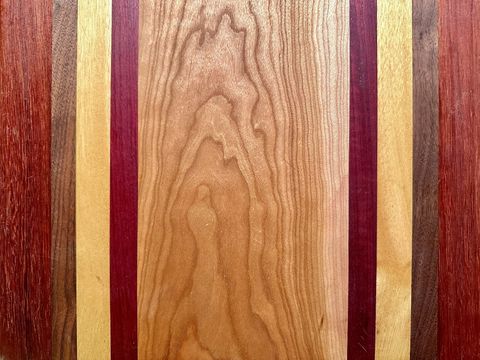
The walnut-and-maple stripe is the benchmark cutting board for a reason — reliable contrast, domestic availability, and a classic look that ages gracefully. But once you've built a few boards and want to push the design further, there's a whole palette of exotic hardwoods waiting. Two of the most striking are purpleheart and jatoba — and when paired with maple or cherry as a neutral, they produce end-grain boards that stop people mid-step in the kitchen.
This guide covers what makes these species worth the upgrade, how to plan layouts that use bold color to your advantage, and what to expect at the bench when working with denser hardwoods.
Why Exotic Woods Are Trending in 2026
Woodworking communities have been buzzing about bold wood pairings this year. Search interest in "exotic cutting board wood" and "colorful end-grain cutting board" has climbed steadily, driven in part by makers posting on social media and buyers wanting something more distinctive than a standard charcuterie board. Purpleheart in particular has become the species everyone asks about after seeing it on a market table or in a friend's kitchen.
It's not just about aesthetics. The exotic species that work well for cutting boards — purpleheart, jatoba, and cherry — also happen to have excellent mechanical properties. You're not sacrificing performance for color.
Purpleheart: The One Everyone Notices
Peltogyne spp. grows across tropical Central and South America. Fresh-milled, it's a muted brownish-purple. Exposed to UV light over the first few weeks, it develops its signature vivid violet. After years of use and oil applications, it settles into a deeper, richer plum.
Key properties:
| Property | Purpleheart | Hard Maple (reference) |
|---|---|---|
| Janka hardness | 1860 lbf | 1450 lbf |
| Grain | Interlocked | Straight/wavy |
| Pore structure | Semi-porous | Closed |
| Moisture movement | Moderate | Low |
At 1860 lbf, purpleheart is significantly harder than walnut (1010 lbf) and noticeably harder than maple — your knives will stay sharp, but so will your router bits and saw blades. Carbide tooling is a must. A sharp hand plane is more forgiving than a poorly tuned jointer when you're truing up glued panels.
One caution with purpleheart: the dust and oils from this species are a moderate sensitizer for some woodworkers. Use dust collection and a respirator, especially on the first few boards until you know how you react.
The visual effect in an end-grain board is dramatic. When you crosscut a glued slab, the end-grain face reveals the rings and pores of each species simultaneously. Purpleheart's fine interlocked grain creates a subtle texture that contrasts with the smooth, even face of maple.
Jatoba: Warm Red-Orange That Anchors a Layout
Hymenaea courbaril, commonly called Brazilian cherry (though it's not in the cherry family), is the red-orange counterpart to purpleheart's cool violet. The color is a saturated rust-to-coral that deepens with age and oil, eventually moving toward a rich cognac red.
At 2350 lbf, jatoba is one of the hardest widely available exotic hardwoods — harder than both maple and purpleheart. This is both its strength and its challenge. It machines cleanly with sharp tooling but punishes anything dull, and it can be brittle at thin cross-sections. Plan for strip widths of ¾ inch or wider to avoid tearout along the end-grain face.
Jatoba's warm tone provides a natural bridge between purpleheart's cool violet and any light neutral in your palette. In a three-species board, the color sequence purple → orange-red → cream maps to a warm-to-cool transition that reads as cohesive rather than random.
Building a Three-Species Palette
The most visually compelling exotic boards usually use three species: two bold colors and one neutral. The neutral functions as visual breathing room — without it, adjacent bold colors can fight each other.
Classic bold combination:
- Purpleheart — the focal accent
- Jatoba — warm contrast
- Hard maple — light neutral
Warm-leaning combination:
- Jatoba — dominant warm tone
- Cherry — softer red-brown (1290 lbf)
- Maple — light neutral
Cherry is worth considering here because it occupies the middle ground between jatoba's intense orange-red and maple's cool cream. It also shares maple's workability and is widely available domestically. A cherry accent strip running between jatoba and maple softens the contrast gradient — useful if you want a refined look over a high-contrast graphic one.
For choosing the best wood for a cutting board, the workability and food-safety criteria all apply equally to exotic species. The short version: purpleheart, jatoba, and cherry are all food-safe when properly finished, and all are stable enough for kitchen use with mineral oil maintenance.
Designing the Layout
The same strip-and-slice construction that works for walnut-maple applies here — but color placement matters more when you have three species.
Strip order decisions:
- Symmetrical: purple-jatoba-maple-jatoba-purple (mirror along the centerline)
- Gradient: maple-cherry-jatoba-purpleheart (warm-to-cool sweep)
- Accent: maple-maple-purple-maple-maple (one bold color as focal stripe)
The accent approach is the most dramatic for a first exotic board. Three or four purpleheart strips centered in a field of maple creates a bold visual without requiring careful alignment of multiple species. It's also the most forgiving to plan — the maple strips can be any width, and a single accent group reads cleanly regardless of minor width variation.
Strip width considerations for exotic hardwoods:
- ¾ inch: fine mosaic; shows off the end-grain ring structure in each species
- 1 inch: balanced — bold enough to read the colors, forgiving enough to work with
- 1¼ inch+: graphic, almost tile-like; works best with the accent layout
The end-grain cutting board design guide walks through the full strip math — how to calculate blank dimensions, how many slices you need for a given board thickness, and how kerf losses affect your final dimensions.
Glue-Up Tips for Dense Hardwoods
Dense exotic hardwoods require a few adjustments at the glue table.
Surface preparation is critical. Jatoba and purpleheart have natural oils that can interfere with PVA adhesion. Wipe the glue surfaces with a clean cloth dampened with acetone or denatured alcohol immediately before gluing — this removes the surface oils without raising the grain. Glue within a few minutes of wiping.
Use a slow-set PVA. Titebond III or equivalent works well. Avoid fast-set formulas — with dense species and many strips, you need the full open time to align and clamp everything before the glue starts to set.
Clamp pressure and squeeze-out. You need squeeze-out on every seam, same as any other species. Dense hardwoods can hide starved joints under light clamping because the boards don't flex or telegraph pressure the way softer species do. Use more clamps, not more pressure — every 6–8 inches along the glue-up is reasonable.
Flattening: A well-tuned hand plane or a wide drum sander handles these species well. Router sleds work but produce tear-out in interlocked purpleheart grain if the cutter isn't sharp. With a router sled, take lighter passes and move in the direction of the grain curl.
Finishing: How Oil Transforms the Colors
Fresh-sanded exotic boards look dusty and flat — don't judge the color until you apply the first coat of mineral oil. The transformation is more dramatic with exotic species than with walnut and maple.
- Purpleheart intensifies from pale lavender to saturated violet on first oil contact. Over weeks of UV exposure, it continues deepening. Over years, it shifts toward plum.
- Jatoba goes from dusty orange to a rich, saturated coral-red. With age and light, it deepens toward cognac.
- Maple warms from cream to ivory, providing a stable backdrop that makes the exotic colors pop.
Apply mineral oil generously on the first treatment, let it soak for several hours, wipe the excess, and repeat two or three times over the first week. A beeswax-and-mineral-oil blend for the final coat adds a slight sheen and slows future moisture absorption.
Plan It Before You Mill
Three-species boards have more design variables than a simple stripe — strip count, species order, strip width ratios, and board dimensions all interact. Sketching this on paper works, but seeing the actual end-grain pattern before committing lumber is a better way to avoid surprises.
Cutting Board Designer includes purpleheart, jatoba, and cherry alongside the standard domestic species. You can arrange layers visually, switch species or adjust widths in real time, and preview the end-grain mosaic in 2D and 3D before cutting anything. The app also outputs a complete cut list — blank dimensions, slice count, strip count by species — so your trip to the lumber yard has a specific shopping list attached.
Bold woods deserve a design process that matches their visual ambition. Plan the layout first, and the build becomes a matter of execution rather than guesswork.